Playbook For Hosting Webinars

Playbook For Hosting Webinars

Last updated on January 3rd, 2025 at 06:34 am

Imagine selling your product or service to hundreds – even thousands – of people without leaving your home.

That’s what a webinar can do.

And when you find the right formula, your webinar can run automatically to close a huge volume of sales while you sleep.

But if you’re reading this, chances are you’ve tried running a webinar and felt disappointed.

  • Maybe only a handful of people showed up
  • Maybe your sales fell way below expectation
  • Maybe you just felt awkward and uncomfortable

Don’t lose hope yet!

In this guide, we’ll share 9 actionable tips from one of the world’s leading webinar experts: Russell Brunson. He’s broken sales records using webinars and knows exactly what it takes to convert.

If you’re ready to turn your webinar into a high-converting sales machine, keep reading!

How Russell Brunson Sold $3.2 Million in a Single 90-Minute Presentation

In 2018, Russell Brunson made history.

After delivering a 90-minute presentation at 10X Growth Conference, he walked off the stage having sold $3.2 million worth of products – setting a world record for the most sales generated from a single presentation. 

But it wasn’t always like that.

Russell’s fascination with sales presentations started back in the early 2000s. 

He attended his first live sales event and, like many in the audience, watched the speakers carefully. One presenter sold a $2,000 course and raked in $50,000 from a single pitch. Then, another presenter took the stage and made over $100,000 in under an hour.

The numbers blew Russell’s mind. 

That moment sparked an obsession: learning how to craft and deliver a sales presentation that converts.

He dove in headfirst, creating his own product and landing his first speaking opportunity. But when he stepped onto the stage and made his pitch, it bombed.

Not a single sale.

Most people would have given up. Russell didn’t.

Instead, he spent the next decade refining his craft, figuring out exactly what makes a sales presentation work. He experimented relentlessly, selling everything from courses and coaching to software and supplements.

Through trial and error, he cracked the code.

A framework that worked every time.

Eventually, it led to that record-breaking moment at 10X Growth Con, which is proof that anyone with the right framework can make a successful sales presentation.

How to Create Your Own “Perfect Webinar”

You might be wondering: “This all sounds great. But how do I actually find an audience to present to?”

“And how do I keep building new audiences over and over again?”

These are the same questions Russell Brunson faced in 2014 when he co-founded ClickFunnels. Using the sales presentation framework he had perfected, Russell adapted his pitch for an online webinar. 

It wasn’t an instant success – it took trial and error.

But eventually, it worked.

Russell ran the same webinar nearly 70 times before automating it. The results? ClickFunnels generated $14 million in sales in its first year.

Since then, his online training Perfect Webinar Secrets has helped hundreds of entrepreneurs boost their sales. Many have even gone on to earn a prestigious 2 Comma Club Award – an honor given to ClickFunnels users who generate over $1 million in sales through a single funnel.

But here’s the thing: success isn’t just about having a great script.

A script alone won’t make sales without an audience. 

The real secret? 

Funnels.

Russell uses funnels to:

  • Generate leads
  • Nurture those leads so they’re primed to attend your webinar
  • Convert leads into sales and collect payment at the end

Without a funnel, even the best script and the most irresistible offer will fall flat.

That’s why, in the next section, we’re starting with probably the most important tip of them all: how to run a high-converting webinar using a funnel.

Flowchart titled "Perfect Webinar" outlining introduction elements, key secrets for content delivery, and closing strategies, with a focus on engagement and rebuilding belief patterns.

10 Tips to Run a High-Converting Webinar Using a Funnel

1. Use a Funnel to Promote Your Webinar

One of the biggest advantages of a webinar over a live presentation is how simple it is to run.

  • No logistics
  • No event planning
  • No booking venues
  • No travel
  • No catering 

Your only overhead? A web hosting platform.

But there’s another, even bigger, advantage: you can easily run the same webinar over and over.

Once you’ve nailed your pitch, you can deliver it every week – or even automate it – to sell the same offer (or multiple offers) for as long as you want. 

The secret to doing this? 

A funnel.

Without a funnel, your audience will dry up. Sure, you could email your list or share a link on social media. But what happens once everyone has already seen it? You’re stuck.

A funnel solves that problem by constantly bringing in fresh leads and turning them into webinar attendees and paying customers. You can even perfect the art of converting new leads using paid or organic traffic.

But that’s not all. 

A funnel offers other game-changing benefits, like:

  • Adding upsells, downsells, and cross sells to boost your webinar revenue.
  • Nurturing new leads with sequences that build excitement and improve attendance rates.
  • Following up after the webinar to generate additional sales.
  • Monitoring and analyzing performance so you can tweak your strategy for better results.

Want to build a high-converting webinar?

A funnel is your first step.

(PS. If you grab Perfect Webinar Secrets today, you’ll get access to 7 pre-built funnels that are proven to convert. They’re all hosted on the ClickFunnels platform co-founded by Russell Brunson which he uses to sell all his products and services.)

Diagram of a sales funnel with icons for Instagram, TikTok, Facebook, LinkedIn, and Google leading to "Your Sales Page" and "Your Upsell Page" showing statistics for visits, sales, and income.

Get Russell Brunson’s “Perfect Webinar Secrets” for Just $7!

2. Understand What You’re Really Selling

In the first section of Perfect Webinar Secrets, Russell Brunson makes a crucial point: you’re not actually selling a product or service.

What you’re really selling is a result.

Think of it this way: your audience isn’t buying software, coaching, or a course – they’re buying the solution to a problem or the outcome they desire. Your job during the webinar is to explain a framework for success that delivers that result.

Your product or service is part of the framework, but it’s not the star of the show. 

The framework itself needs to be so compelling, and so clear, that it motivates people to take action. They should believe that using your strategy is the key to unlocking the transformation they want.

Remember this concept when crafting your webinar.

Illustrated funnel framework for teaching, showing four steps: story (learned & earned), framework list, tactics, and social proof/examples with an icon for each step.

3. Figure Out Your “Big Domino”

The first 15 minutes of your webinar are critical. 

This is where Russell Brunson recommends telling your origin story – a powerful narrative designed to grab attention and build trust. But the story isn’t just about entertaining your audience. 

It has one key purpose:

  • To knock over the “big domino.”

In every sales pitch, your audience has objections. There’s always one major objection that stands between them and making a purchase. 

This is the “big domino.” If you can knock it down, all the smaller objections will fall with it – making your prospect far more likely to buy.

But here’s the catch: you can’t tackle multiple objections. 

Russell found that when he tried to address more than one big objection in a webinar, conversions dropped by half. Instead, you need to focus on just one big belief your audience needs to accept. 

Craft your origin story – and your entire webinar – around hammering home this belief.

4. Create Your Script

Russell Brunson’s world record $3.2 million at 10X GrowthCon and the ClickFunnels webinar that generated $14 million in its first year have one thing in common.

They used the same script structure.

In fact, many of Russell’s students have used it to generate millions in sales as well.

It’s built to flesh out a 90-minute presentation.

Why 90 minutes?

Because it’s the sweet spot for keeping your audience engaged while delivering enough value to close the sale. In Perfect Webinar Secrets, Russell teaches a specific framework designed to run about 90 minutes, broken down like this:

  • Origin Story (15 minutes) – Your introduction, where you capture attention and build trust.
  • The Vehicle (15 minutes) – Introduce your framework and break down the first major belief.
  • Internal Beliefs (15 minutes) – Address limiting beliefs your audience may have about themselves.
  • External Beliefs (15 minutes) – Tackle objections related to outside factors or resources.
  • Stack and Close (30 minutes) – Present your offer, highlight its value, and close the deal.

There are plenty of ways to write a webinar script, but the key is to use a framework like the one in Perfect Webinar Secrets.

Once you have a framework, you can tweak it.

5. Stack Before You Close

After spending an hour telling your story, breaking down beliefs, and showing your audience how your framework delivers results, it’s time to ask for the sale.

But here’s the question:

  • Do you just say, “Buy this now for $X,” and call it a day?

Not quite.

According to Russell Brunson, there’s a much more effective way to close: the “stack & close” strategy.

Why is the Stack & Close Important?

In a live sales conversation, you can handle objections by answering questions directly. But in a webinar, you don’t have that luxury. Instead, you need to preempt objections by presenting each element of your offer one by one – and making it clear how each piece solves a specific problem or adds value.

But there’s more.

If you simply list everything and then reveal the price at the end, your audience will fixate on the last thing they saw: the price. This can lead to hesitation or sticker shock.

The Stack Strategy:

With the stack, you:

  1. Present one part of your offer.
  2. Reiterate what’s included: “You’re getting this… and this… and this.”
  3. Continue stacking each element until your audience fully grasps the value.
  4. Finally, reveal the price – but now the price is associated with the entire stack of value, not just the last item on the list.

By framing your offer this way, you shift the focus from cost to total value.

For a deeper dive into mastering this strategy, there’s a 2-hour video training inside Perfect Webinar Secrets – so grab it if you want to learn more!

Person presenting a slide titled "The Last Step: Ask Permission to Make an Irresistible Offer and Present it Through The 'Stack.'" Slide includes icons and a 30-minute timer.

Get Russell Brunson’s “Perfect Webinar Secrets” for Just $7!

6. Check Your Analytics

If you have already attempted to host a webinar but found that it didn’t result in many conversions, don’t give up.

Go back to the performance of that webinar and take a much closer look at the analytics.

This will give you more of an idea as to what registrants and attendees were interested in and also what made them uninterested. If you used a webinar provider to host your webinar, then they should already offer an analytical dashboard.

(ClickFunnels has its own webinar hosting and analytics.)

If you have yet to host a webinar, then double-check with a provider so that you can get all the data you need to work on improving your webinars, so they are high converters.

Below are our recommended metrics to look at.

Click-Through-Rate

In order to have a high-converting webinar, you will need people actually to attend it, so one of the first things you need to look at after hosting your webinar is the click-through rate.

This is calculated by dividing the number of registrants by the number of people who clicked on your registration page.

This will help you determine whether improvements need to be made to the registration page to make it more appealing.

According to Mike Agron’s general benchmark, a high click-through rate could be anywhere between 34% to 50% but an ideal click-through rate is anywhere between 25% to 33%.

Anything below that is when you need to be concerned.

Show-up Rate

Next, you want to have a look at the attendance rate because not all of those who registered to attend will actually attend.

To calculate your attendance rate, divide the number of people who attended the webinar by the number of people who registered. This will then help you determine whether your follow up emails are working and whether you have the right demographic audience.

Russell says a typical show-up rate can be 25% – so don’t be disheartened.

Think about how you can improve follow-up emails and who you are targeting if your attendance rate is below this benchmark.

One strategy that people use is providing a ‘sticky’ gift.

What’s a sticky gift?

Providing something like a worksheet ahead of the webinar when they register so they are more likely to do the work between registering and showing up.

Ask yourself, what type of ‘sticky gift’ can you use?

Drop Off Rate
The next performance figure you want to pay close attention to is the drop-off rate.

This is calculated by dividing the number of people who left the webinar by the number of people who attended. If your webinar provider has it, you should also be able to see what time during the webinar people dropped off.

Knowing this will help you determine whether your webinar is interesting enough and also whether it provides any value to those who attend.

It may also be because your webinar is too long, but you won’t know this unless you review the drop-off rate.

Replay Conversion Rate

If your webinar offers valuable tips, then it is something attendees will want to refer back to, therefore, replay the webinar. They may even want to save on training costs and replay it to their employees or team.

Whatever the reason, it is good to monitor the replay conversion rate to judge whether or not your webinar was of use to those who attended. If the replay conversion rate seems low, then it is time to start thinking about how you can add more value to your webinars.

This could be with unique statistics, innovative ideas, or even by doing a Q&A chat at the end of the webinar.
With your replay conversion rate, it’s also important to consider that people may have needed to leave the presentation early but will watch the ‘sale’ or ‘pitch’ part of the webinar in a replay.

So it’s important that the offer is strong.

Again, to find the reasons behind lots of these questions, you’ll need to dig into the analytics of your webinar and webinar funnel.

Close Rate

Russell says that if 5% of people who attended your webinar buy… you have a “good” webinar. 

If 10% of people buy… then you have the potential to scale your webinar to 7-figures.

When creating his webinar for ClickFunnels, Russell ended up seeing a 15% close rate. If you can achieve this, then the sky’s the limit.

Follow Up Email Sequence Rate

Sometimes those who register for the webinar simply don’t attend because something important came up and not because they are not interested anymore. This is why you should be sending out a sequence of follow-up emails to those who registered but didn’t attend.

You can then determine whether it was for other reasons registrants didn’t attend or whether it was a lack of interest.

You will know if it is a lack of interest that resulted in registrants not attending if the replay rate is low.

But you should also be emailing people who did attend but didn’t buy.

Russell says it’s common to double the sales during or directly after your webinar by effectively scheduling and using follow-up emails 

7. Split-Test Until You Have a Winner

Here’s the truth: your first webinar probably won’t be perfect. 

And that’s okay. 

Even Russell Brunson, the master of high-converting webinars, didn’t hit it out of the park on his first attempt. But what made the difference? Split-testing.

Why Split-Testing is Key

During the early days of ClickFunnels, Russell tried five different funnels – none of them worked. He didn’t give up. Instead, he dug into feedback, made adjustments, and kept testing.

One breakthrough moment came after an event where he spoke about ClickFunnels.

Afterward, someone told him they weren’t interested because they thought funnels were only for selling supplements. That feedback was a goldmine. Russell went back, added more examples to show how funnels could work for any business and tried again.

How Split-Testing Led to $100K+ in Sales

Russell once did two webinars back-to-back in a single day, bringing in about $30,000 in sales.

But he didn’t stop there. 

He exported all the webinar comments, analyzed them, and tweaked his script based on what people were asking and where they were getting stuck.

The next time he ran a webinar for a similar audience, the result? 

Over six figures in sales!

But he didn’t stop. He kept testing, tweaking, and refining – running the same webinar 70 times before automating it.

Split-testing isn’t just about minor tweaks. It’s about listening to your audience, making data-driven changes, and constantly improving your presentation until it converts consistently.

It’s almost impossible to get it right the first time.

8. Keep the Technology Simple (But Effective)

Many of your target audience will be using different browsers, versions, and devices so you need to try and accommodate them all.

When checking for a webinar provider and host, then make sure there are no long connection speeds or buffering issues.

Keeping it simple is usually best.

Visuals

Talking of visuals, let’s move on to the more commonly used method of hosting webinars.

You can present a visual webinar that could be a presentation of slides while you talk through them, an animated presentation, or a live webcam feed… depending on how comfortable you are in front of a camera.

A live webcam feed may be riskier than presenting a slide presentation as depending on connection times; sound could be 15 seconds behind which will lead to viewers dropping off.

This could be a problem if you have a high attendance but not so much if your attendance is narrowly targeted.

Q&A Chat
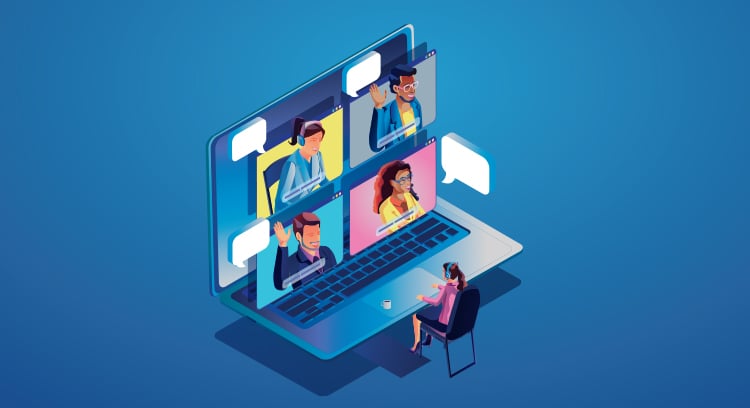
If you want to be more interactive with your attendees and keep them from dropping off, host a Q&A chat towards the end of the webinar.

During the webinar, viewers can submit their questions and a moderator will decide which to hand over to you to answer at the end.

You won’t be able to do this as you’ll be too busy doing the webinar presentation.

You can answer any questions you didn’t answer during the webinar by email after the webinar.

This is a great way to gather information for your buying personas and also to determine what your viewers want to learn more about for your next webinar.

Polling

This is another great way to gather information from your target audience to be able to create better content that reaches out to their needs and wants.

You can ask something like “Have you come across this problem” or “Is this technique you will try”.

You can ask this at some point during the webinar when it is most relevant.

Keep the poll simple and straightforward and don’t have too many in one webinar.

Usually, one poll within one webinar is enough.

Surveys
You can run a survey at the very end of your webinar to again gather information from those who attended.

By asking the right questions, you should be able to get a good idea as to whether your webinar has increased the chance of attendees converting.

You can then use these valuable results to help nurture those attendees through the sales cycle.

The one thing is not to make the survey general and too long.

This will put people off from completing it.

9. Practice Live First

In order to have a high-converting webinar, you are going to need to practice your script beforehand as well as make notes and slides for quick reminders during the live webinar. You want to instill trust and confidence into those who are attending, which stuttering and often saying “errrrm…” is not going to do.

If you are doing a slideshow presentation, you also don’t want to simply read from the slides either.

This will bore attendees as they will think they could have just read it for themselves.

Instead, you can offer opinions, thoughts, and ideas based on the topic of each slide if you are doing a slideshow style webinar.

As always, storytelling is a powerful webinar recipe.

The more of your personal story you can use to share with the listeners (while paired with a few other strategies we listed above) the stronger your webinar will be and the higher it’ll convert. Once you have the right webinar scripts in hand, you’re ready to practice until you are almost perfect at it.

10. When You Have a Winner, Automate it

Once you’ve fine-tuned your webinar and hit on a script that converts, it’s time to take the next step: automation.

This is exactly what Russell Brunson did with his ClickFunnels webinar. After refining it through countless iterations and perfecting every element, he recorded it – and automated the entire process.

Why Automation is the End Goal

Imagine generating sales around the clock without having to show up live. 

That’s the power of an automated webinar. It allows you to run traffic – whether organic, paid, or earned – and convert leads into customers while you sleep.

With automation, you’re not limited by time zones or availability. You can reach a global audience, scale your sales process, and keep the momentum going 24/7.

How to Automate the Right Way

In the Perfect Webinar Secrets training, Russell provides actionable tips for setting up and running your automated webinar. You’ll learn how to:

  • Schedule your webinar on a weekly basis, creating a consistent experience for attendees.
  • Use targeted sequences and follow-ups to nurture leads and boost conversions.
  • Move leads through your funnel from cold prospects to loyal buyers, using example cadences designed for maximum impact.

The best part?

You don’t have to start from scratch. When you invest in Perfect Webinar Secrets, you’ll get seven pre-built, one-click funnel templates—each proven to drive results. These templates take the guesswork out of building your funnel, so you can focus on running traffic and generating sales.

Ready to automate your success? This is how you do it!

A flowchart outlining a weekly webinar sales process, featuring steps like promotion, live webinars, Q&A, replay, and sales tactics. Includes elements of emotion and logic.

Get Russell Brunson’s “Perfect Webinar Secrets” for Just $7!

Using ClickFunnels to Build a Webinar Funnel in Minutes (Instead of Months)

One of the biggest challenges when setting up a funnel is the time and complexity involved.

Traditional website building can take months, with coding, design, testing, and revisions. But with ClickFunnels, you can create a high-converting website funnel in just minutes – no tech skills required.

The Power of the Drag-and-Drop Editor

With ClickFunnels’ intuitive drag-and-drop editor, building your funnel is as easy as moving elements around. 

You don’t need to worry about learning code or hiring a developer. Simply choose the elements you need – landing pages, order forms, emails, and more – and drag them into place. It’s that easy.

Here’s a couple more reasons why ClickFunnels is one of the most popular platforms for building and scaling webinars:

  1. Save Time and Effort: Instead of spending months setting up a website and funnel, you can have everything up and running in just a few hours. The pre-built templates and customizable elements give you a head start, so you can launch faster and start seeing results sooner.
  2. No Need for Technical Knowledge: You don’t have to be a tech expert to build a fully functional, high-converting funnel. ClickFunnels makes it accessible to anyone, whether you’re a beginner or a seasoned marketer. Plus, with built-in tutorials and resources, you’re never left on your own.
  3. Seamlessly Integrates with Your Marketing: ClickFunnels is designed with marketers in mind. It integrates easily with your email list, payment processors, and more. You can track your funnel’s performance in real time, making it easier to optimize and scale your campaigns.
  4. Flexibility to Customize: While ClickFunnels offers drag-and-drop simplicity, it also gives you the flexibility to customize each funnel to fit your unique branding, products, and sales strategy. You can change colors, and fonts, and even create unique pages for different offers.

In just 15 minutes, you can build a funnel that looks professional, performs well, and drives sales. It’s fast, efficient, and designed to scale with your business. 

With ClickFunnels, you have the tools you need to create a website funnel that converts—without the hassle.

Want to build a high-converting webinar sooner rather than later?

We recommend you grab the Perfect Webinar Secrets training and then take advantage of ClickFunnels’ 14-day free trial to put it to work and make your first few sales.

Get Russell Brunson’s “Perfect Webinar Secrets” for Just $7!

Final Thoughts: High-Converting Webinar Funnels

In this article, we’ve covered 9 key tips for running a high-converting webinar, from creating a compelling sales funnel to refining your script and automating your process. 

The two most important points are:

  1. Use a proven framework for crafting a webinar script that sells
  2. Use a funnel to generate a constant flow of leads and sales

By understanding the importance of your framework, and story, and overcoming objections, you can craft a webinar that resonates with your audience and boosts conversions. 

With ClickFunnels, you can build your website funnel in minutes, making it easier to generate leads and sales without the tech headaches. 

Ready to take your webinars to the next level? 

Grab Perfect Webinar Secrets today for proven strategies and pre-built funnels that work!

Get Russell Brunson’s “Perfect Webinar Secrets” for Just $7!

Leave a comment

Your email address will not be published. Required fields are marked *

11 thoughts on “Playbook For Hosting Webinars

  1. I love all of your articles Stephen. Can you please do an article on designing the perfect webinar landing page? Thanks!

  2. What are the 4 stories told inside the perfect webinar? Russel speaks of them. Are they separate webinars with a completely story or are they 4 stories told inside one single webinar?

  3. What are the 4 stories told inside the perfect webinar? Russel speaks of them. Are they separate webinars with a completely different story or are they 4 stories told inside one single webinar?

  4. This is a great how to on how to set up a successful webinar. I’ve learned promoting is a huge part of success as well.