


Last updated on August 17th, 2026 at 06:02 am
Looking into Leadpages, or wondering if there’s a better landing page tool out there for what you need? The plans, the pricing, and nine other tools you should know about are all covered here.
Here’s the short version. Leadpages costs $99 a month for its Grow plan, or $199 a month for Optimize, both cheaper if you pay annually.
Leadpages Pricing Explained
Grow is Leadpages’ entry plan, running $99 a month, or $79 a month if you pay for the year upfront. It includes up to 500 pages and 10 custom domains, along with A/B testing and dynamic text replacement built in from the start, no need to upgrade just to test a headline against another one.
Optimize runs $199 a month, or around $159 a month billed annually, and includes everything Grow does, plus a few things aimed at teams running more traffic. Smart Traffic automatically routes visitors to whichever page version is converting best for people like them. Heatmaps show where visitors are clicking and scrolling. And auto-personalization changes what a page shows based on who’s looking at it.
But despite those differences, one thing holds true across both plans. Neither one caps how much traffic a page can get. A page on Leadpages’ cheapest plan can take in the same volume of visitors as one on its most expensive plan, with no overage charge or forced upgrade once a campaign takes off.
Leadpages also runs a new-customer discount right now, half off the first month on either plan, Grow at $49 and Optimize at $99, before the price returns to normal the following month. That’s good to know before signing up, since the first bill will be less than the others.
Above Optimize, there’s one more tier, but it’s not for everyone. It’s built for larger operations, and Leadpages doesn’t list a public price for it, it’s quoted directly by their sales team based on what an account needs.
But for someone building and testing landing pages without a big team, Grow covers what that work needs. Optimize makes more sense once there’s enough traffic that automatic routing and heatmaps earn their cost, instead of using separate tools to get the same result.
What Is Leadpages, and Where Does It Fit
Leadpages is a landing page builder, built for creating individual pages fast rather than running a whole business through it. Someone running paid ads, launching a webinar, or collecting emails for a single offer can go from a blank page to something live in a short amount of time, without needing a designer or a developer involved.
Where Leadpages earns its reputation is speed and simplicity. The page builder itself doesn’t require much of a learning curve, and A/B testing is included from the entry plan instead of gated behind a higher tier the way some competitors handle it. For someone whose entire job is a single page converting well, that combination is hard to beat.
Where people tend to outgrow it is anything past a single page doing a single job. Leadpages doesn’t build multi-step funnels, doesn’t include email marketing or a CRM, and doesn’t handle checkout the way a dedicated funnel tool does. Someone selling through order bumps, upsells, or a multi-step sequence usually ends up connecting Leadpages to two or three other tools to make that work, rather than running it all from one place.
So it all comes down to the job in front of you. A single page that needs to convert well, Leadpages does that. But a full sales process with more steps than one page can hold, that’s a different tool’s job.
If you want the two compared side by side in more detail, our full Leadpages vs ClickFunnels comparison walks through that.
Alternatives at a Glance
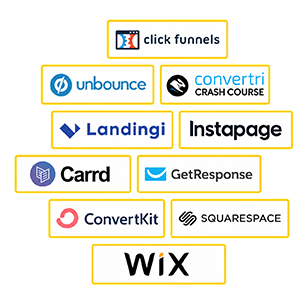
| Alternative | Starting Price | Best For | Standout Feature |
|---|---|---|---|
| ClickFunnels | From $97/mo | Building a full sales funnel, not just a single page | Checkout, upsells, and email built into the same platform |
| Unbounce | From $99/mo | Teams focused on conversion testing | AI-assisted copy and page optimization |
| Convertri | From $99/mo | Prioritizing page load speed | Built-in video that doesn’t slow the page down |
| Landingi | From $29/mo | Teams wanting detailed visitor behavior data | Built-in event tracker for analyzing engagement |
| Instapage | From $99/mo | Paid traffic campaigns with distinct audience segments | Personalization based on visitor-level ad data |
| Carrd | Free; paid from $9/yr | A single simple page, such as a portfolio or link page | Lowest cost on the list |
| GetResponse | From $19/mo | Combining email marketing with landing pages | Strongest as an email platform first |
| Kit (formerly ConvertKit) | Free; paid from $39/mo | Creators monetizing an audience directly | Paid newsletters and digital product tools |
| Squarespace | Around $16/mo billed annually | Design-focused websites that also need landing pages | High-quality templates |
| Wix | Free; paid from around $17/mo | Full websites with AI-assisted building | AI chat-based site builder |
Where ClickFunnels Fits

If a single landing page won’t cover what you’re building, if there’s a multi-step offer, an upsell, or a webinar funnel behind it, this is the alternative to check out. If the term’s new, our guide to what a sales funnel is covers the basics first.
ClickFunnels is built around sales funnels, not single landing pages. Its landing page builder is part of a larger system that also handles checkout, email marketing, courses, memberships, and a CRM, all connected to the same funnel a page belongs to.
For someone who only needs one page to collect emails or promote a single offer, that’s more than the job requires. But for someone selling through a multi-step sequence, an order bump, an upsell, or a webinar that leads into an offer, ClickFunnels is built specifically for that path, not just the page at the start of it.
Plans start at $97 a month, or $81 a month billed annually, with pricing that scales based on contacts and email volume rather than the number of pages or funnels built.
Try ClickFunnels free and see checkout, upsells, and email all working together in one funnel.
#2: Unbounce

Unbounce is a landing page builder that is known for its emphasis on conversion rate optimization. Plans start at $99 a month.
Its core functionality includes a landing page template library, a drag-and-drop page editor, pop-ups, sticky bars, and A/B testing.
The company has also incorporated artificial intelligence into its software with AI copywriting and AI optimization functionalities.
AI copywriting features enable you to instantly generate copy for your ads, landing pages, emails, and more.
Meanwhile, AI optimization features enable you to automatically route visitors to the landing pages which have been proven to work best for people with similar demographic traits.
You can test unlimited landing page variations, create high-converting landing pages for each customer segment, and then automatically direct visitors who belong to that segment to the relevant landing page.
#3: Convertri

Convertri is a funnel builder best known for its page loading speed, and pages built with it do load fast, which is likely to help conversion rates. Plans start at $99 a month, though pricing on this one varied a lot across sources.
Convertri’s core functionality includes five funnel templates that cover the most common use cases, more than 200 page templates, and a page editor that gives you unprecedented control over how your pages look.
It also offers an exceptional video functionality that enables you to embed videos without slowing down your pages.
Video does add some load time no matter which player it’s on, but Convertri’s version adds a lot less than embedding a standard YouTube video would.
In addition to that, there are a bunch of other neat features such as video backgrounds, interactive videos, sticky videos, timed videos, and more.
If you intend to rely heavily on video content then you might want to go with this funnel builder because it’s unrivaled when it comes to video.
It’s also worth mentioning that the company has built its own content delivery network (CDN) to ensure speed, robustness, and security. If Convertri’s system goes down, your funnels will stay up.
Read our full Convertri review:
“Convertri Review For 2024 – All You Need To Know About Convertri”
#4: Landingi

Landingi is a landing page builder that puts emphasis on collecting and analyzing data. Plans start at $29 a month, after Landingi dropped its free plan earlier this year.
Its core functionality includes a template library, a page editor, and A/B testing.
Meanwhile, its event tracker feature enables you to collect granular data that you can then analyze to better understand user behavior. That can help you optimize your landing pages for conversions.
There are also several AI features: you can use artificial intelligence to generate landing page copy, optimize your content for SEO, and remove backgrounds from images.
Finally, there’s an e-commerce functionality, but it appears to be pretty basic and is designed for selling digital products as opposed to physical ones.
Landingi covers the basics of building and testing a landing page well, and the event tracker is a useful extra most competitors don’t include. It’s a solid fit for anyone whose main need is straightforward page creation with some behavior data layered on top.
#5: Instapage

Instapage is a landing page builder that seems to be geared primarily toward helping its users convert paid traffic into leads and customers. Plans start at $99 a month.
Its core functionality includes a template library with more than 500 landing page templates, a page editor, and A/B testing.
Then there’s the personalization functionality that you can use to personalize visitor experience based on the visitor’s intent.
This functionality enables you to automatically match the copy of your landing page to visitor-level data such as keywords, demographics, and firmographics.
There’s also the AdMap functionality that you can use to visualize the structure of your ad campaigns, evaluate both the pre-click and post-click stages for ad-to-page relevance, and map your ads to personalized landing page experiences.
Instapage’s personalization tools are built for paid advertising specifically, matching page copy to different audience segments based on the ad someone clicked. That makes it a strong fit for anyone running several distinct customer segments through paid campaigns.
#6: Carrd

Carrd is a website builder that was designed to help you create one-page websites, including profile pages, portfolio pages, and landing pages. Carrd is free to start, with paid plans from $9 a year.
It offers a library of page templates and a page editor that you can use to customize them.
While the landing page templates look good, it’s unclear whether they have been optimized for conversions.
If you want to start building an email list for a hobby project, Carrd might be an option worth considering.
However, building a full email list usually calls for a tool with more email marketing depth behind it, which several of the other options on this list are built around specifically.
#7: GetResponse

GetResponse is an all-in-one marketing platform. Plans start at $19 a month.
It started as an email marketing tool and has expanded over the years into a broader suite that also covers websites, landing pages, and marketing funnels.
Email remains its strongest area, with autoresponder sequences, one-off broadcasts, behavior-triggered automation, and a library of templates to build from.
Beyond email, GetResponse includes a website builder, a landing page builder, and a funnel builder, each with its own templates and the option to generate pages using AI. It also supports paid newsletters, online courses, and webinars.
For someone building an email list for a smaller project, the email tools cover what’s needed without much extra complexity. For a business already selling a product or service at scale, the platform can feel lighter than tools built specifically around that.
#8: Kit (formerly ConvertKit)

Kit, formerly known as ConvertKit, is an email marketing platform built to help creators grow and monetize an audience. Kit is free to start, with paid plans from $39 a month.
Kit covers email marketing, landing pages, and opt-in forms, each with its own template library and editor, built around getting a creator’s list growing quickly.
On monetization, Kit supports paid newsletters, digital product sales, and paid services like coaching. It also runs its own sponsor network, connecting creators with advertisers in exchange for a cut of sponsorship revenue and a processing fee.
The free plan covers up to 10,000 subscribers, which makes Kit accessible for someone just starting to build an audience, not only for creators who’ve already grown one.
#9: Squarespace

Squarespace started as a website builder and has since expanded into a broader marketing platform. Plans start around $16 a month billed annually.
Its website and landing page templates stand out, known for polished, design-forward results, available either through the drag-and-drop editor or an AI tool that builds a site from a short set of questions.
Beyond design, Squarespace includes email marketing, blogging, and SEO tools, along with monetization options like memberships, paywalled content, online courses, bookings, and an online store.
Design quality doesn’t always mean a page is built to convert, so it’s worth checking whether a template’s polish comes with the conversion tools a landing page specifically needs, especially compared to tools built primarily around that.
#10: Wix

Wix is a website builder that has expanded into a broader marketing platform. Wix has a free plan too, with paid plans starting around $17 a month.
Its template library covers over 900 designs, customizable through a drag-and-drop editor or an AI builder that generates a site from a written description of what’s needed.
Beyond design, Wix includes SEO, email marketing, appointment booking, a CRM, and e-commerce tools.
As with any design-first platform, it’s worth checking whether a template’s polish comes with the conversion tools a landing page specifically needs, the same consideration that applies when comparing Wix to tools built primarily around that.
Read our full Wix vs. ClickFunnels comparison:
“Wix Vs. ClickFunnels: Which Website Builder Is The Best?”
That’s the lineup, single-page builders on one end, full funnel software on the other, and several strong options in between. For a wider look beyond landing page tools specifically, our roundup of the best sales funnel software covers more ground.
Frequently Asked Questions
How much does Leadpages cost?
Leadpages costs $99 a month for the Grow plan, or $199 a month for Optimize, both cheaper with annual billing. New customers get their first month at half price on either plan.
Is Leadpages free?
No, but it comes with a 14-day free trial that doesn’t require a credit card to start. There’s no permanent free plan once the trial ends.
What is Leadpages used for?
Leadpages is used to build and test individual landing pages, things like a page collecting emails for a lead magnet, promoting a webinar, or selling a single offer. It’s built for the page itself, not for running email marketing or checkout on the back end.
Is Leadpages worth it?
For someone whose main need is a single page that converts well, yes, A/B testing is included from the entry plan and there’s no traffic cap at any tier. For someone running a multi-step sales process with upsells or a CRM built in, a different tool usually fits better.
What’s better than Leadpages for building a full sales funnel?
ClickFunnels, if the goal is more than one page. It connects the landing page to checkout, email, and everything else in a multi-step funnel, which is outside what Leadpages is built to do on its own.
And if ClickFunnels isn’t the right fit, the nine other tools above cover a range of budgets and use cases.